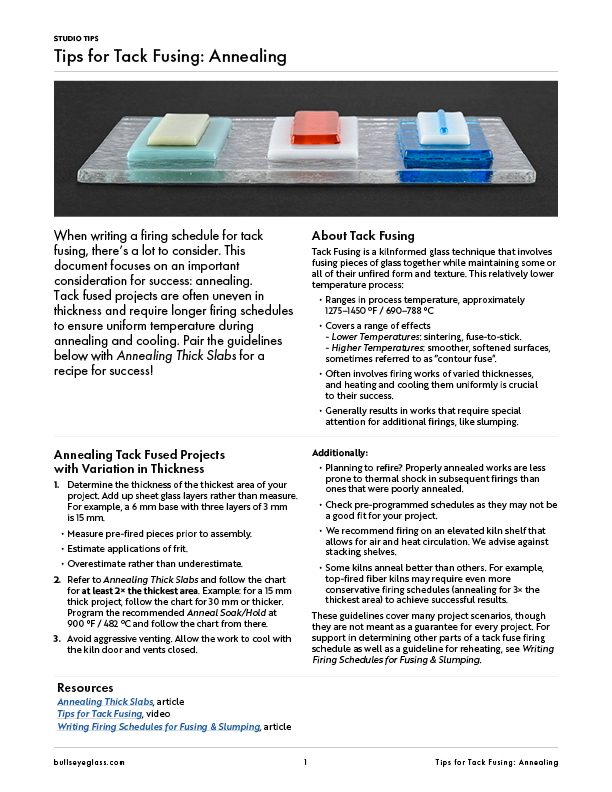
When writing a firing schedule for tack fusing, there’s a lot to consider. This document focuses on an important consideration for success: annealing.
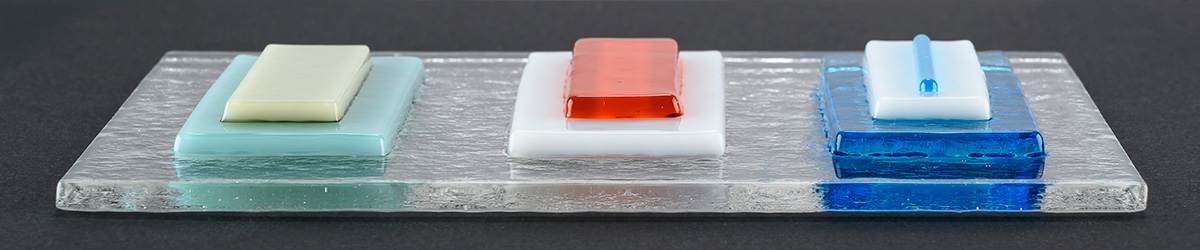
Tack fused projects are often uneven in thickness and require longer firing schedules to ensure uniform temperature during annealing and cooling. Pair the guidelines below with Annealing Thick Slabs for a recipe for success!
About Tack Fusing
Tack Fusing is a kilnformed glass technique that involves fusing pieces of glass together while maintaining some or all of their unfired form and texture. This relatively lower temperature process:
- Ranges in process temperature, approximately 1275–1450 °F / 690–788 °C
- Covers a range of effects
– Lower Temperatures: sintering, fuse-to-stick.
– Higher Temperatures: smoother, softened surfaces, sometimes referred to as “contour fuse”. - Often involves firing works of varied thicknesses,
and heating and cooling them uniformly is crucial
to their success. - Generally results in works that require special attention for additional firings, like slumping.
Annealing Tack Fused Projects
with Variation in Thickness
- Determine the thickness of the thickest area of your project. Add up sheet glass layers rather than measure. For example, a 6 mm base with three layers of 3 mm is 15 mm.
• Measure pre-fired pieces prior to assembly.
• Estimate applications of frit.
• Overestimate rather than underestimate. - Refer to Annealing Thick Slabs and follow the chart for at least 2× the thickest area. Example: for a 15 mm thick project, follow the chart for 30 mm or thicker. Program the recommended Anneal Soak/Hold at 900 °F / 482 °C and follow the chart from there.
- Avoid aggressive venting. Allow the work to cool with the kiln door and vents closed.
Additionally:
- Planning to refire? Properly annealed works are less prone to thermal shock in subsequent firings than ones that were poorly annealed.
- Check pre-programmed schedules as they may not be a good fit for your project.
- We recommend firing on an elevated kiln shelf that allows for air and heat circulation. We advise against stacking shelves.
- Some kilns anneal better than others. For example, top-fired fiber kilns may require even more conservative firing schedules (annealing for 3× the thickest area) to achieve successful results.
These guidelines cover many project scenarios, though they are not meant as a guarantee for every project. For support in determining other parts of a tack fuse firing schedule as well as a guideline for reheating, see Writing Firing Schedules for Fusing & Slumping.
Resources
- Annealing Thick Slabs, article
- Tips for Tack Fusing, video
- Writing Firing Schedules for Fusing & Slumping, article