A police officer, a 911 dispatcher, and a forensic scientist walk into a building…
This isn’t the setup to a joke. In Central Point, Oregon, it’s the start of a shift for about 130 people entering the region’s newly renovated police command center. For these folks, an average day typically involves someone else’s worst. Crime? Catastrophe? Emergency? Trauma? It’s all part of the job. Theirs is that seemingly paradoxical kind of work that demands compassion to do well and a thick skin to do at all.
When artist Sumi Wu set out to design a permanent installation for this environment—submitting a proposal as one of several under Oregon’s Percent for Art program—she quickly recognized that the core challenge was not architectural, theoretical, technical, or even thematic. It was human. For her art to really shine, it would somehow need to help counter the likes of numbness, cynicism, and empathy fatigue.
Complicating this task was the fact that Wu could not physically experience the site. Unlike many of her public works, she didn’t get to stand in the space, sense its scale, or observe its rhythms. Instead, she had to work from afar, informing her imagination through architectural drawings and 3D renderings. From that sort of abstract distance, certain clues become key. And within the renderings, she noticed something promising: a large window at the base of the main atrium stairwell, a switchback spine at the building’s heart. Daylight.
That was the prompt Wu needed. The presence of a significant natural light source clarified her direction immediately. “I’m always looking for any excuse to use glass in a project,” she admits. A polymath who works in everything from dance to sculpture to set design, Wu holds a particular love for glass—its transparency, its responsiveness, the way color behaves inside it. In her words, it’s the juiciest, most delicious of materials.
With the material and the site relationship taking shape, she turned to concept. Having grown up among physicists at Los Alamos and having studied physics herself before moving toward art, Wu retains a fascination with structures that recur in nature at every scale. For Central Point, the idea that took hold—Watershed—emerged directly from that scientific impulse. In the Rogue Valley, everything is shaped, sustained, and connected by water. And from that base of connection, the ecosystem grows upward.
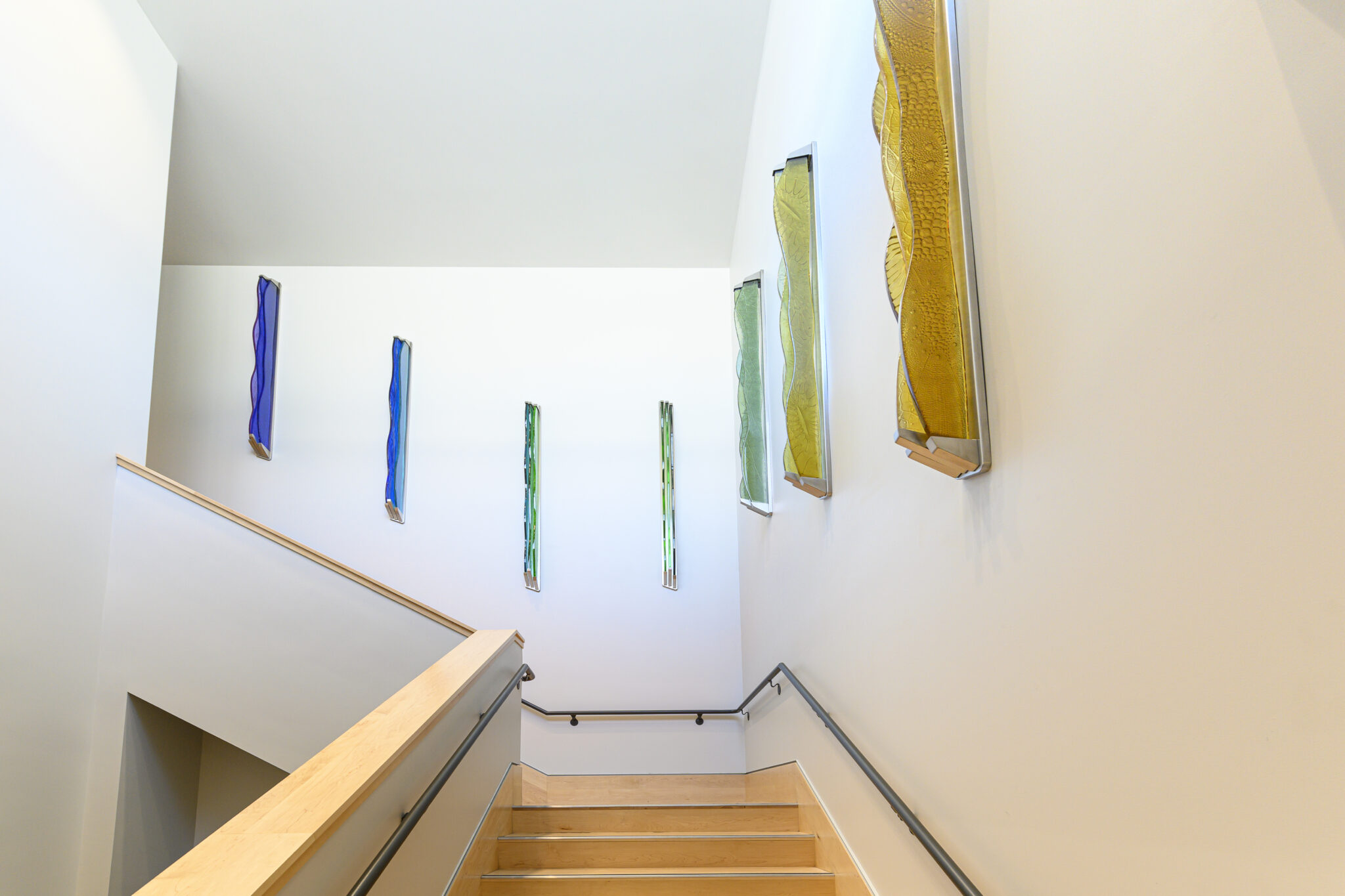
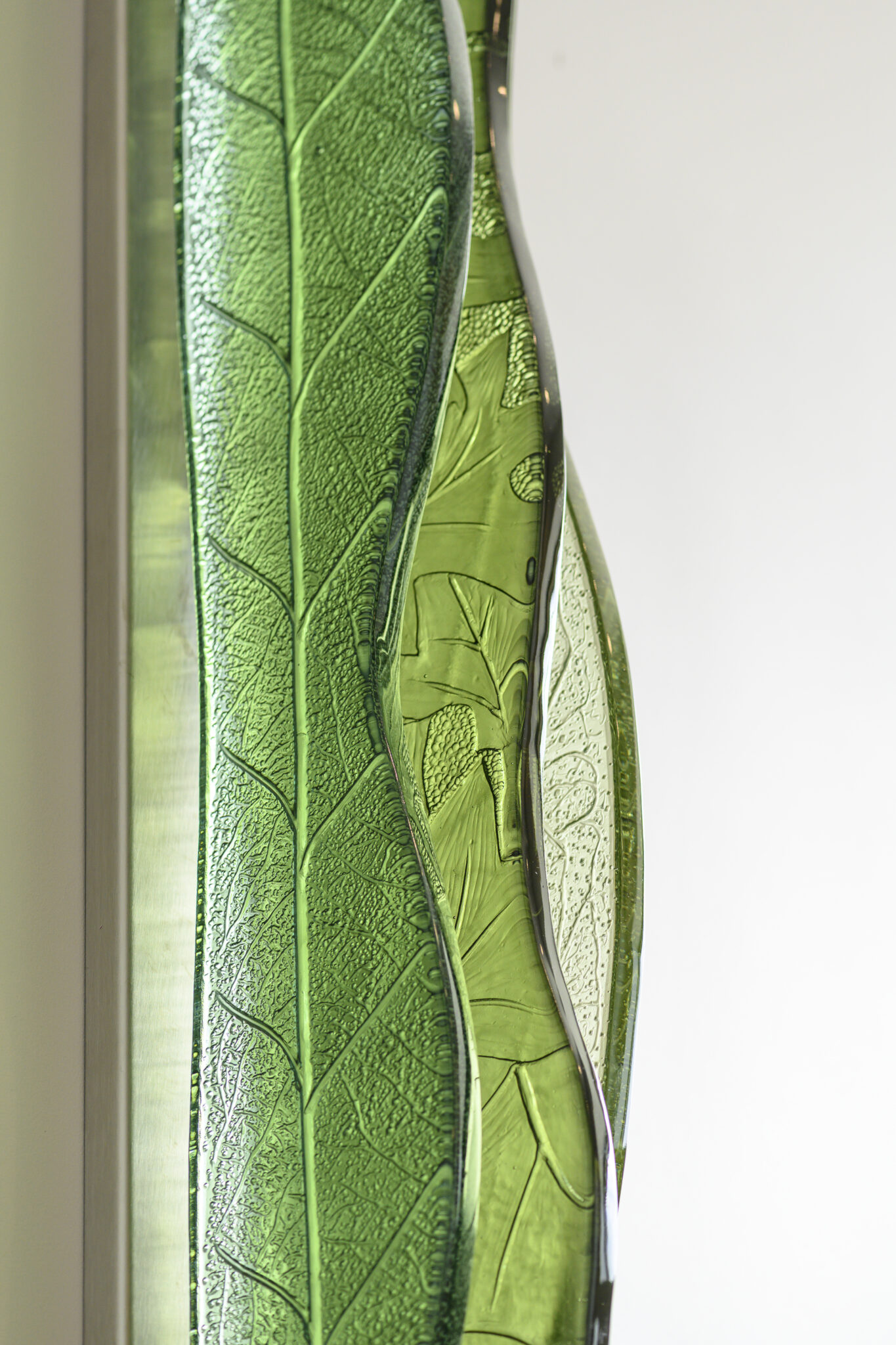
Her proposal imagined seven “waterfalls” of glass rising with the stairway, a chromatic climb from the warm reds and ambers of earth to the greens of understory and canopy, then upward into the blues and violets of sky and celestial space. Each waterfall would consist of stacked, transparent slabs roughly three-quarters of an inch thick, their surfaces carrying sculpted imagery: root webs, leaf veins, seeds, deltas, constellations, gravity webs. Mounted slightly off the wall on a stainless-steel armature, the structure would visually echo the Oregon State Police core values of honor, integrity, loyalty, and dedication, while the glass itself would interact with light to accomplish its restorative work.
“Everything in nature involves repeating webs,” Wu explains. “Roots, mycelium, river systems, gravity. They’re all connected structures of similar type, just at different scales.” Watershed would make that continuum of connectivity visible. Walking its stairs would become a journey from the microscopic to the cosmic—an illuminated reminder that even moments of crisis exist within a broader, sustaining whole.
Wu ultimately won the commission, emerging from a competitive finalist pool. With the project officially hers to realize, she began translating her proposal into a fabrication plan. At first, she hoped to handle the entire installation herself. Wu is a hands-on maker who relishes building complex sculptures in her own studio. But Watershed required kilnforming at a level of size, precision, and durability that gave her pause.
Early consultations with Bullseye Studio—and a series of test firings—proved pivotal. The process helped Wu move forward with confidence in carving the design imagery in clay, knowing her ideas would translate with visual clarity and depth once cast in glass. A visit to Bullseye’s Concept Library further crystallized her direction. Seeing cast glass works in person confirmed her impulse to shape clay originals that could be molded and cast rather than fused or assembled. The medium itself began to assert its logic.
After discussions with Bullseye Studio’s Ted Sawyer, Wu made the difficult-but-liberating decision to entrust the fabrication to the Studio. Looking back, she breathes a sigh of relief. Her own kilns would have forced compromises—shorter slabs, more seams, intrusive metal supports, and limits on polish and optical clarity. Bullseye’s expansive kilns, deep experience with stacked casting, and extraordinary fidelity to sculpted texture allowed Watershed to emerge without compromise.
“It would’ve been a much poorer piece if I’d tried on my own,” she says without regret. “Working with the Studio made sure the material could do all it’s capable of. I couldn’t be happier with how things turned out.”
The special beauty of cast glass, Wu notes, truly comes alive in how the work engages the site. As people ascend the stairs, they encounter the shaped edges and layered colors directly. As they descend, they look through the full depth of the glass, where textures accumulate and refract. In practice, Wu arranged the slabs so that from either direction—ascending or descending—the viewer looks through thickness, not just at a carved surface. The imagery reveals itself optically, through depth, unless one looks closely to locate the carved faces nestled between the undulations of the slab edges.
Watershed, now installed, enriches the atrium’s natural light. As the sun shifts, so does the artwork. Purples brighten into blues. Greens settle into ambers. Textures sharpen or soften depending on cloud cover, weather, season, and whether the viewer is moving quickly, pausing mid-landing, or catching a glimpse from the mezzanine.

Wu designed the piece for these fleeting encounters. Staff pass it dozens of times a week—sometimes too quickly to stop, sometimes lingering. At a glance, the waterfalls read as calm, vertical presences against white wall and steel. Up close, they offer discoveries: the ribs of a leaf, a constellation of spores, the suggestion of a starfield.
“I wanted it to be generous on both levels,” Wu says. “Something you can feel in passing, and something you can really look into.”
Since installation, employees have written notes to express how Watershed has lifted their spirits. It has reminded them, in unplanned moments, that the world outside remains connected and alive—full of forces and patterns larger than any single emergency call or case file. They’ve been struck by how much difference a little light and color can make on dark days.
For Wu, the notes affirm her hope for the piece and its ongoing work. The glass seems to be doing what she asked of it: quietly, patiently giving people heart.You’re not alone.
You’re not just beating the wind.
You’re part of something larger—something beautiful, something unfolding.
And that matters.
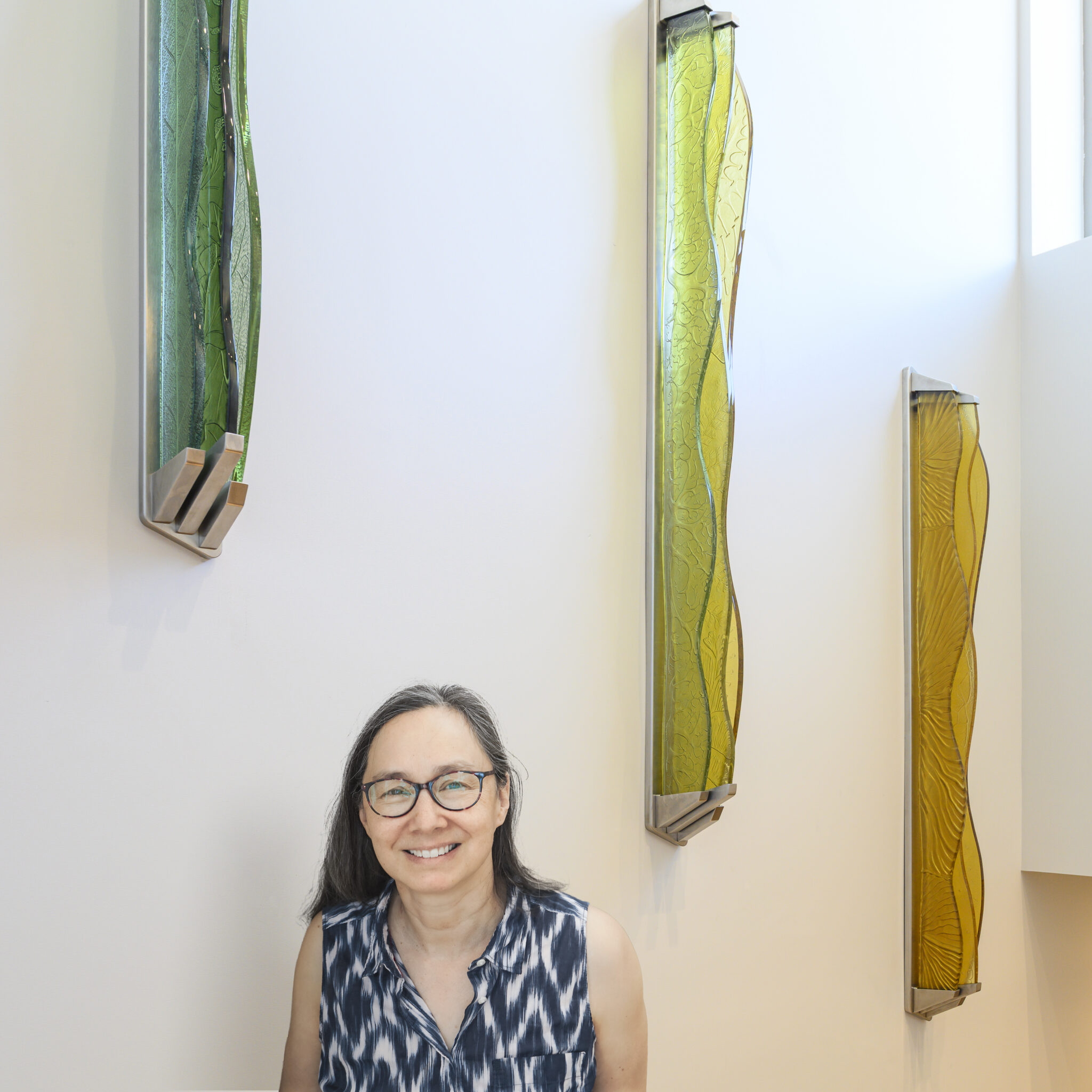
Artist Sumi Wu with the installed artwork, Watershed.